Sunday, July 30, 2017

I do not believe in empirical science, I only believe in apriori truth

Kurt Gödel on the left


The above was a quote from Kurt Godel, my favourite mathematical logician. Many people do not know about this man but his discovery of profound mathematical truth is more earth shattering than what was attributed to Einstein in the realm of physics. Besides, his life was not dogged by allegations of plagiarism unlike that of Einstein's special and general theory of relativity, in which some alleged he copied this without attribution from several physicists.

Gödel is known for his 1st and 2nd Incompleteness Theorem which has application to philosophy and theology.

Anyway, my point is the quote and why I too agree with Gödel.

Science relies on empirical and physical observations for its facts. In this regard, like other mathematicians, I do not believe mathematics is part of science. If at all I view it as part of philosophy. The second part of the quote, on apriori truth, is what is lacking in science. Here Gödel meant axioms. What are axioms? These are statements that are accepted to be obviously true. Its truth is established in the inherent nature of what language suggest. An example of an axiom is this - A or NOT A. Either A is true or NOT A is true. It cannot be both. This is obviously true.

I hate to break this but there are no axioms in Physics or in any branch of Science. The so called physical laws are formulated by observation but they are not universally established.

The strongest we can see in physics that comes close to an axiom is causality - Cause precedes the effect and never the reverse.

First, at best this is a philosophical principle we can agree, but at worst is the idea that the reverse cannot happen. In other words, this law does not allow for "if and only if" relationship. 

Let us illustrate, If Charles is a father, then he must have a child. But having a child by Charles by default, then Charles has become a father too. Here two things happened, and the cause became an effect as well. 

Because there are no axioms in the sciences, that is, there are no self-evident true statements, science is not stable. It cannot be your absolute source of truth, it cannot be the absolute arbiter of a situation. It cannot have the last say.

This is the reason why science keeps updating its pronouncements. Remember, the time when doctors said salt is bad for you, which again doctors saying, yes it is good etc. etc.

This is not to say that I will not use some of what science says, like take my medicines. What it does mean is that it cannot be your God, it can be your slave, but never your Divine Maker.

Often, when I see statements made by people hailing science and thus, scientism, I suspect the individual has no inkling how science and so called scientists work.


Monday, June 26, 2017

Why I am sceptical of science and scientists


You might think this strange because if you know me I work in academia most of the time and since I dabble in mathematics you would think that I should not be negative towards science, for after all isn't mathematics a part of science?

In large science faculties, it is true that mathematics is part of the science faculty but I do not think mathematics is part of science. Science deals with observations of phenomena in our world. From, particulars it abstracts to the general. Science deals then with induction.

Mathematics does not deal with induction, it does not look at particulars and then infer to the general. No, mathematics deal with deduction, from the general we go down to particulars. In this regard, I think really that mathematics should be part of philosophy.

We do not sample every triangle we could find, measure their internal angles to be a total of 180 degrees and assert that all triangles have an internal angle of 180 degrees. We use logical proofs starting from axioms.

Today science enjoys a celebrity status. If you want to gain the trust of people just tack on the word "science" into what you are doing. So we have library science, meat science, dairy science and game science and what not. The field I work in my consulting is "Data Science". Funny but I went to a conference last month and a leading practitioner in the field, a professor himself, complained that there is no "science" in data science.

The world has evolved to the point that science is operating like a religion. What is awful is that it is operating like a cult as well. In the age of the Internet, things have evolved and it is easy to be arrogant and know it all. Because the Internet gives one a capacity to be semi-anonymous, people are happy to be rude and insulting to those who disagree with them. It is easy now to express without hesitation one's disdain for a fellow who might be slow in catching one's level of knowledge.

Here are my reasons ordered by importance

1. It does not always work. The reason is that when scientists observe, they are only observing a sample of a phenomenon and when one produces generalisations from these, it by default left out some parts of the phenomenon. Today the approach taken by computer scientist in doing Artificial Intelligence (AI) is to abandon the idea of deterministic certainty, but embrace and live with uncertainty and work on probabilities. Ask yourself, does the science you believe in behave in an arrogant certainty?  AI computer scientists have chucked the idea that something can be determined with certainty from the world. So the models they create for a phenomenon using AI are probabilistic. 

2. Most scientists today have no training in philosophy. I worked for a while in computer science and the computer scientists I have encountered have no appreciation of the role philosophy plays in their craft.If they are not scared of it, they either consider it as useless or indifferent towards it. The same is true in physical science. Steven Hawking said philosophy is dead. No offence but I think Hawking and I will be long gone and philosophy will be around. This is bad science and bad scholarship. The reason why we have this situation of science acting like religion is that philosophers have allowed them to roam, be arrogant and unchecked.

For example, the issue of causality vs correlation. When I went back to statistics, my colleagues and textbooks reminded me that correlation does not imply causation.
This is illustrated in a Chinese saying:
Does the flowers blooming bring about spring? Or does spring bring about the blooming of the flowers? You might think it is the latter for sure - but think and pause for a moment. It is an epistemological question - meaning - how to we know something is true or real..

Also this - is there only one way of explaining a physical phenomenon? Should we entrust our lives and our view of the world into the what scientists say?

Here is one quote from a philosopher of science about science...

Even though some scientists and many pseudo-scientists voice their allegiance to that (scientific) method, no modern philosopher of science would be unaware of at least some of its shortcomings. Modern developments in the philosophy of science have pinpointed and stressed deep-seated difficulties associated with the idea that science rests on a sure foundation acquired through observation and experiment and with the idea that there is some kind of inference procedure that enables us to derive scientific theories from such base in a reliable way. There is just no method that enables scientific theories to be proven true or even probably true.

                                                      ---- A. F Chalmers (What is This Thing Called Science)

Maybe I am influenced too much by the mathematician I admire and respect who said...

I do not believe in empirical science, I only believe in a priori truth.
                                                            - Kurt Godel

Later I will add more, like my thesis that scientists are not altruistic people who are also influenced by personal agenda using science to advance their goal.
Please remind me.

Monday, May 15, 2017

So I saw the film The Case For Christ

My big impression on this? Respect. I respect the spirit of in which this film was made. Some of the points that I would like to make are the following:


  • This film is as much the story of Leslie, the wife of Lee. Here we see the persecution experienced by a Christian wife living with a non-Christian husband.
  • The parallel story of Lee's work on the Hicks case along with his investigation of the validity of the Christian claim I thought made the film more than a re-enactment of an evangelical testimony.
  • There is much we can learn on the way the film depicted the interviews Lee made with professional NT scholars, historians, and scientists, some of whom are non-Christian themselves.
  • The role of providence in the life of a Christian.

Finally, there is a suggestion of a mild decisional theology in the film. Though I myself no longer practice this "accepting Jesus into your heart" by way of the "sinner's prayer". I seem to recall somewhere the wisdom of Martin Luther who said somewhere, to words to this effect -- the person asking God in prayer already believes, that is to say, the person already believes in Christ, before he even asks God to move on his behalf. We should ask God to save us after all. The focus, fair enough, should not be in our act of asking but the God who saves those who call upon his name.

We do not have to be triumphalistic and be offended at all in that.


Saturday, August 27, 2016

Why a Christian can believe Christ will never leave him nor forsake him

In Matt 28:20, we read  20 Teaching them to observe all things whatsoever I have commanded you: and, lo, I am with you always, even unto the end of the world. Amen.

Many years ago, during times of great trial I would come to this verse to no avail for I could not find any reason why I could claim this promise. You see I look at myself, I see my sin, my failures to live up to God's standards and coming to this verse with all of those staring back at me only made my heart sink in despair.

Only lately have I found confidence in the promise found in that verse and the one in Heb 13:5
 for he hath said, I will never leave thee, nor forsake thee.
How can I claim such a promise? Dear friend it is not because of anything inside you, but simply because Jesus bled and died for you. That is the reason why we can have confidence that Christ will be with us always, unto the very end of the world. It is because Jesus died for you.

At the cross God forsook Christ so that today God does not have to forsake you.

Another fact related to the dying and bleeding of Jesus is our baptism. According to God's Word, in Romans 6, we have been united with Christ at his death, burial and resurrection when we got baptised. God united us with Christ in our baptism.

No matter how it looks in the end, God will lead us back to the evidence for the reason Christ will never leave us nor forsake us, the proof we can rely on this promise is the Cross.

So I tell myself and you, next time you feel God has left you alone, look at the Cross, you will be convinced what you have taught about God is so wrong.

Tuesday, June 21, 2016

Those who have faith in Christ are the ones reconciled to God

I have been reading through Colossians lately as part of my daily devotions, often called "quiet time".
This passage spoke anew to me - Colossians 1
19 For it pleased the Father that in him should all fulness dwell;
20 And, having made peace through the blood of his cross, by him to reconcile all things unto himself; by him, I say, whether they be things in earth, or things in heaven.
21 And you, that were sometime alienated and enemies in your mind by wicked works, yet now hath he reconciled
22 In the body of his flesh through death, to present you holy and unblameable and unreproveable in his sight:
23 If ye continue in the faith grounded and settled, and be not moved away from the hope of the gospel, which ye have heard, and which was preached to every creature which is under heaven; whereof I Paul am made a minister;

When we see the connection of v.20, 21 w v.23  it is plain that those who are in faith and continues in the faith (the assumption here is faith in the atonement, v.22 of Christ) are the ones that enjoy the present reality of being reconciled to God. This faith is the one produced by the hearing of the Gospel, the good news that Christ has died to pay for sins. It is beautiful to see here that the Gospel, faith and reconciliation neatly tied together in one paragraph.


Thursday, December 17, 2015

The Papacy is not Anti-Christ for no reason.

Just the other day I was reflecting on 2 Thess 2:1-7. I noted that the NKJV has this rendition of the passage...
2 Now, brethren, concerning the coming of our Lord Jesus Christ and our gathering together to Him, we ask you, 2 not to be soon shaken in mind or troubled, either by spirit or by word or by letter, as if from us, as though the day of Christ[a] had come. 3 Let no one deceive you by any means; for that Day will not come unless the falling away comes first, and the man of sin[b] is revealed, the son of perdition, 4 who opposes and exalts himself above all that is called God or that is worshiped, so that he sits as God[c] in the temple of God, showing himself that he is God.5 Do you not remember that when I was still with you I told you these things? 6 And now you know what is restraining, that he may be revealed in his own time. 7 For the mystery of lawlessness is already at work; only He[d] who now restrains will do so until He[e] is taken out of the way.

I was noting to myself that textually, the NKJV must have been affected by American Evangelicalism in that in v.7, the NKJV editors capitalised "he" in that passage. This is not the same as what you will find in the KJV. In the KJV it is not capitalised. The Church Fathers viewed this "he" as the Roman Empire. The modern view promoted in Evangelicalism is that the "he" in v.7 stands for the Holy Spirit. So in the NKJV we see it in uppercase. At any rate, this is besides my point now. The matter of textual translation is something we can discuss next time - which in my case, KJV once again is the better translation.
Last week the Vatican released a report entitled  "The Gifts and Calling of God are irrevocable" .  The news media have reported that this document states that the Jews need not believe in Christ to be saved. That is right, you read it well. The passage in the document that teaches this is found 2/3 of the way in the document...
That the Jews are participants in God’s salvation is theologically unquestionable, but how that can be possible without confessing Christ explicitly, is and remains an unfathomable divine mystery.

So therefore, the Jews are saved even without confessing Christ, this reality is an unfathomable mystery? This is blasphemy!

The Roman Church is the Apostasy mentioned in 2 Thess 1:3, the falling away. In this Vatican document, we see an example of how the Roman Magisterium opposes Christ  and His many words that speak of the necessity to believe in Him. The Papacy indeed is Anti-Christ. This document exemplifies how the Roman Church is the spiritual whore spoken of by St. John the Apostle. Hear the words of Christ ...
John 8: 24 I said therefore unto you, that ye shall die in your sins: for if ye believe not that I am he, ye shall die in your sins.
Speaking to the Jews, Jesus said in John 8.
42 Jesus said unto them, If God were your Father, ye would love me: for I proceeded forth and came from God; neither came I of myself, but he sent me.43 Why do ye not understand my speech? even because ye cannot hear my word.44 Ye are of your father the devil, and the lusts of your father ye will do. He was a murderer from the beginning, and abode not in the truth, because there is no truth in him. When he speaketh a lie, he speaketh of his own: for he is a liar, and the father of it.45 And because I tell you the truth, ye believe me not.46 Which of you convinceth me of sin? And if I say the truth, why do ye not believe me?47 He that is of God heareth God's words: ye therefore hear them not, because ye are not of God.


Monday, October 26, 2015

Australian Lutherans decided not to be like Episcopalians (for now)

I am speaking here of Women’s Ordination (WO) to the Pastoral Ministry.

This October 2015, at the Lutheran Church of Australia General Synodical Convention the proposal for WO did not pass the required two-thirds majority vote.

I wrote “for now” in the title of this post, because the issue of WO has the habit of bubbling back up to the surface from time to time.

I remember back in 2006 at Lutheran Church Australia’s convention that the issue of (WO) was decided then and as the result today as it did then, WO did not meet the requirement.

I could feel the disappointment of those who favour WO so much that I believe some of them need grief counselling because of this result (n.b., I am not being disrespectful here). I mean this in a sympathetic way even though everyone who has been in this blog know that I wrote against WO.

I am against WO because I do not think Scripture or Church History supports it. You can read about my position on this in this blog.

Being against WO is no small thing if you knew where I journeyed before coming to Lutheran Theology. I was for 25 years a Pentecostal and WO in Pentecostalism is no issue, they welcome WO with open arms. Pentecostals do not even talk about if it is right to ordain women, for with them anyone can be ordained if the person is “baptised in the Holy Spirit” without respect for the gender. Gender is no issue but this so-called 2nd baptism of the HS is. Pentecostals are not “catholic” in many levels and in many ways.

Anyway, today I wish to put on my analytical hat and analyse the numbers as reported in the LCAus website. There were 423 registered delegates. 145 voted NO, 269 voted YES. This totals 414. That means we got 9 abstaining.

So let us look at the stats. 34% voted NO, 64% voted YES, 2% abstaining. Now note, if we look at the majority, they are FOR WO. If not for the two-thirds majority rule they would have won already. That rule saved the anti-WO.  The 64% YES vote in terms of people lacked 13 people to tilt their position to 66%.

So 13 people did not vote for YES. That is not a lot of people. Where could pro-WO have gotten these votes? It could be taken from the 145 who voted NO, at least some of them; or they could get all if not some from the 9 people who abstained. So what does this tell both the anti-WO and pro-WO? It says that pro-WO would just need to work a little bit more and they will get it next time but the anti-WO have to be vigilant and work harder. The pro-WO would just need a few more campaigning and lobbying. On the other hand the anti-WO would have to be in the defensive, they would have to be guarded.

I have a question that bugs me. I was under the impression that the LCAus synod sought in prayer the Holy Spirit’s mind on this when they got together in 2006. My question is this – if they sought the mind of the HS in 2006, why talk about it again in 2015? If the synod got their answer in 2006 and the answer was no, why did they have to decide on this again in 2015? I mean does the HS change His mind from time to time? I say this because I was under the impression that they prayed to the Holy Spirit about this. That was the language I heard when they spoke about this issue. So do they actually believe the HS has guided them to this answer in 2015? If so can the people be relieved of any fear of this surfacing again in the future?


Thursday, July 30, 2015

Waltherians consider CF Dub Dub better than Lutheran Scholastics?

That is right dear friends, UOJ Waltherian Huberites consider CF Dubya Dubya, better theologian than Gerhardt, Leyser, Hunnius and more.
Credits: Dr. Ichabod

Well, what can I say but...WOW.

How could you pay homage and so much respect to the guy who has inferior exegetical abilities than Hunnius or Gerhardt? The guy who relied on translations rather than deal with the original Greek and Hebrew? Did the Old Orthodox Lutherans rely on translations? No, they were careful exegetes skilled in the original languages.  How could one lean on Walther rather than the ones who were there in the writing of the Formula of Concord?

Now, Walther could be correct in some area against the Lutheran Scholastics - but that would be an accident, a stroke of luck but not due to skill.

I am skeptical of Lutherans who easily dismiss Old Orthodox Lutherans. Yet today I hear Lutherans who criticise Luther, and even somewhat embarrassed of him when in fact they have not read Luther himself.

Frankly when you survey the things CFW said I would label him as unconscious Calvinist.

You might object to me and say - wait a minute LPC - CFW Walther wrote against Calvinism and criticised Calvinists. Well, you see Evangelicals criticise Calvinism too but their denial and separation of the Holy Spirit from the Word and from the Sacraments make them unconscious Calvinists.

Ever heard of false flags? You could raise the flag of Lutheranism but behind the scene you have another flag in your left arm, the real one, which undermines the one you have raised. Now far be it from me that CFW was a purposeful false flagger. Sincere people could be wrong and could have adopted a position just like the position they have been attacking.

I would like you to read this old post on the critique of Walther's method and his lack of exegetical abilities.

Fortunately it is only in the USA were Walther is revered -  for example a pastor I interact with, from German origin who migrated to Australia, is as skeptical towards Walther as I am. Another pastor gave snide remarks about the teachings of Walther. I would not be surprised to hear from an American Lutherans tell me that those people are heretics for doubting Walther.

Why is Walther considered the guru of American Lutheranism? Walther's method was to quote Luther, the Confessions and the Lutheran Fathers. In doing so, it gave his would be hearers an air of Walther being faithful to the Lutheran Orthodox tradition. When in fact he was actually mis-quoting them, and in real fact, his position contradicted them! We must remember that when Walther was a disciple of Stephan, Stephan's followers drank with loyal fervour the sayings of Stephan, when Stephan was booted out of the scene, the same unquestioning loyalty simply transferred the Walther.

This is the explanation of Dr. Karl Edwin Kuenzel...(emphasis mine).

... Walther’s method of citing Luther and the Lutheran dogmaticians...  was wrong both in principle and in practice. The problem was that unlike Luther, who stressed the Bible and the study of the Bible, Walther’s positions neither rested directly on Scripture nor did they lead one directly into it. Instead he strongly stressed, to the extreme, the importance of Luther and the Lutheran Confessions and the Lutheran fathers, and certainly much more than he cited God’s Word. Utilizing this format Walther led people to think that the matter under discussion or being presented had been established sufficiently by the quotations from Luther and the fathers; therefore it was unnecessary to study Scripture. This format actually hampered people in their use and study of the Bible. And eventually, it has come to the point where the citation theologians not only quote Luther and the old fathers but now they have also included Walther and others as proof of the doctrinal stand. As pastors, theologians, and theological students took up the study of doctrinal maters in subsequent years the subject of study was not as much a study of the Bible as it was a study of old synodical reports and conference and convention essays. And now quotations from these, not the Bible, are frequently used to support doctrinal positions.
...
However, it was unsettling to have Walther take a firm stance on a matter citing the Lutheran fathers as his proof, yet not realizing that at the same time his position was in contradiction to what they had written' 

I think the reason why UOJers hold to Huber's view of Justification is because to them Walther believed it and has already established the issue and therefore, it is settled with no need to unearth (for them) or review the issue. Walther believed it, we should too. Duh?

I tell you what, do you want to be accepted by "confessional" American Lutherans? Pay homage to Walther and quote him too... Lord have mercy.


Monday, June 29, 2015

Lutherans entertaining a bad idea.

The topic of this post is the ordination of women to the pastoral office.

Women should serve in the church. There should be no question, the question is in what capacity? In what role(s)? The Lutheran Church of Australia this October 2015 will deliberate on the ordination of women to the pastoral ministry. I wonder why I have this suspicious feeling that should it pass (because it failed many years ago), some ministers, in time, would leave this synod.

I have read some arguments favouring the ordination of women. Some interesting arguments do not argue exegetically though they claim that their arguments are based on the text of Scripture. Most of these arguments are theological using Justification of the believer as the ticket for either male or female to vie for the pastoral office. In this post I will use the following lines of thought to establish my case why I do not buy into the idea of ordaining women to the ministry. I will use my training in the Biblical languages to argue exegetically, then historically and lastly behaviourally why ordaining women to the pastoral office renders Lutherans in LCA irrelevant. Amazingly when I was a Pentecostal, this was not a problem for me, why is it a problem now? Hopefully in lining up my exegetical, historical and behavioural reflections will enlighten you why I do not buy ordination of women to the pastoral office.

1. Exegetical.

The best question I believe one should ask exegetically is this - do we have texts from Scripture that women were pastors during the time of the Apostles? What were the terms used by Scripture for pastors and was this applied to any women characters mentioned in Scripture? One line of reasoning I have read is the mention of women in the house churches greeted by St Paul. In other words, since St Paul was greeting these women where house meetings are happening, they say that is proof positive that women were pastoring in the early church. What comes to mind are women mentioned in Romans 16, such as Phebe. She was called a servant of the church in Cenchrea. The word "servant" as used in the KJV  was for διάκονος, this is where we get the word deacon.  This is someone who carries out the orders of another. In fact it means attendant, someone who waits for instructions and carries them out. Yet others in favour of women's ordination latch into this and translates this word as "minister" broadening the significance of the word, thereby arguing that Phebe was a pastor too. This is not correct, the word deaconess is quite narrow, it is one who attends to the poor and distributes money collected for their use.

The there is the issue of Priscilla in Acts 18:26. Some argue that the "fact" (it is alleged) Priscilla was mentioned first in Romans 16:3, that shows that Priscilla had a dominant role between her and her husband Aquila. If one looks when these two people are named in Scripture, and we argue on the basis of first mention as being important, this argument is shot down. For in 1 Cor 16:19, in the Greek NT, Aquila was mentioned first. Now was Priscilla really mentioned first in Acts 18:26? Only if you go by an eclectic Greek NT Text, this is NOT so in the Textus Receptus(TR). In Acts 18:26, Aquila was mentioned first!  Six times Priscilla was mention in Scripture, and using your eclectic Greek NT, 3 times Priscilla comes first and other times Aquila comes first thrice. Not so in the TR, we get 4 times Aquila coming first and only twice did Priscilla get mentioned prior to Aquila. If we follow this idea, then the Women's Ordination people appears to interpret Scripture by brute force.  If carries no solid conclusion.

Then there is the allegation that Priscilla taught Apollos on her own in the home church setting! There is no such text in Scripture I can find that Priscilla ever taught anyone without Aquila being there. Such suggestion is more imagination than exegesis. You would have to have a very active imagination to suggest that Priscilla taught Apollos on her own (without the presence of her husband).

I dare say that indeed, those who promote women's ordination on the basis of house churches found in Acts are letting their imagination run wild - going forward where Scripture is silent.

So let us go back to the words used by the Bible to refer to pastors. We can name two - the first we have is episcopos επισξοπος  were we get the title Bishop or Overseer and then the word prysbeteroous πρψβετερους where we get the word Elder or Presbyter. The first word occurs in 1 Tim 3. We can rule out that St Paul ever had in mine women to be Bishops here. The reason is that he used the pronoun he, and referred to this office as a person having one wife etc. All we need is to deal with the text of Scripture and it ought to be obvious that he had no idea that this could be an either male or female role.

The other one we need to deal with is the word elder or presbyter. Now, there was the office of old widows mentoring the younger women apparently this can be found in Ellicott's Commentary.   This is where this word might be applied to a woman. It is like an order in the Church. In other words, a woman who is by reason of age is a senior in the church whose job is to be a spiritual mentor to the younger women specially the younger wives. I am getting ahead of myself in discussing the historical aspect of this post, but more of that later. When St Peter and St Paul addressed the church, they used the masculine form of presbyter. Note that St Peter considered himself also as an elder in 1 Pe 5:1.

The last word is that of pastor - poimen (ποιμήν) - which is from the word "shepherd".  In Eph 4 is the only place I know where this word occurs. However, it is attached to the idea of eldership. For example St Peter in 1 Pe 5:1 instructed his fellow elders to "shepherd" the flock of God. Most of the time, that title is reserved for Jesus - who is the Good Shepherd - the real Pastor of the Church. Since Jesus is male, by analogy, elders shepherding God's people from the male population fits the parallelism well. Besides, the job of herding sheep in Bible times was never regularly performed by women. It is unlikely that St Peter had women elders too in mind when he said this about shepherding God's people.

2. Historical.

We have no surviving tradition of women holding the office of pastor in any known ancient Christian denominations from either the West or the East. I think this is a fair statement. It is probably of significant consequence. For there there is plenty of evidences of women in the priesthood of pagan cults. Correct. The pagans had no qualms in having women lead them in their religious affairs. In Ancient Egypt and Greece, women had already been in the forefront of religious leadership. It stands to reason that since pagans have female goddesses, it is natural that their priest who should mediate between the goddess and the people would be a woman akin to the goddess itself. See for example in the Eleusinian Mysteries. It is possible that this is one of those matters that made Christianity different from pagan religions - that of not having female leadership.

Then there were mention of women attending the altar around 400-500 AD. It is usually in and around a male presbyter who has become a heretic. So sure you will find some women who performed the role of priest in the churches but they were congregations with suspicious orthodoxy. You can find inscriptions of women being called presbytera but that does not mean they presided over the church as shepherd for as we said, there were these elderly women in church whose job was to teach younger women.

The most brief treatment of this issue is found here in a Christian History Institute Article.

Why we should look at history for this question? It is because the same way we treat the Canon of Scripture. For example it is known that St Paul wrote a letter to the Laodecians. What if suddenly historians found a papyri purporting to be that letter of St Paul? Are we going to rip our New Testament and make room for this letter to be included in our NT? I venture, no Christian will do such a thing. The reasons is that there is no tradition stating or which evolve to this effect that St Paul's letter to the Laodecians is Scripture. Therefore because we do not have clear evidence first from Scripture that women served as pastors (no question, the served as deacons!) neither from history (other wise we would see them operating in church, when we got born into this world of which we know the church is older than us) then in this counts it is deviant to to ordain women now in the pastoral office.

3. Behavioural.

Let us face it women are numerous in church than men. Let us for the sake of argument we ordained women into the pastoral office. Then yet again, that is one more reason for men to abdicate their duty and console their conscience leading them to further laziness, cowardice and indifference to the call for ministry. As a man, I know how to reason and make excuses. Hey wait there is one keen woman here who wants to do the work, problem solved, just let her do it just like she does at home. We go sit in the couch and watch TV.

I cannot pin point what are the motivations of these present male ministers advocating for women in the pastoral office - is it really because they see it in Scripture? I am finding it hard to believe this because most arguments I have seen were either dramatical, emotional or bereft of fair even handed exegesis. Or something else is motivating this, perhaps a hero complex?  Yeah sure ladies, I will advocate for you to be in the pastorate, I will be your hero, we got equal rights in the church too.

Often times I see Roman Catholic apologists hurling insults at Lutherans along this line - how dare they say they are more catholic than us Romans?

Well, when the Lutherans start ordaining women into the pastorate - I'd say they have left catholicism itself. They lose their right to claim a return to the catholicism that is Biblical and Evangelical. Certainly such a synod is not catholic anymore.

Monday, May 11, 2015

Westcott-Hort Axiom on Textual Criticism Does Not Pass Statistics

I was with the King James Version of the Bible when I first believed. Sometime in the late 1980 I started toying with other versions of the Bible. One of the most disgusting versions I have come across is the NIV, so I am sorry if you are a fan of this Bible translation, as I am not.

However through the years I let NASB, NRSV and now ESV hang around my library and when I was pastoring  I even preached from these.

Now that I have more time, I have recently in the last couple of weeks studied a bit this matter of Textual Criticism.

I process of copying Biblical text by the ancients was an extremely and complex human activity and the axioms of Westcott and Hort people are very simplistic and do not account the physics of this writing process.

Let me give a few examples of why for a trained mathematician the following axioms must be rejected. Now we know that these textual criticism axioms are not like mathematical axioms that are self evidently true. TC axioms are not like this of course but these TC axioms are not even scientific.
Here are the axioms I reject.

1. Manuscripts are to be weighted not counted.
Now what is the rational of this? Well we can say that simply because it is many does not mean it came from the original. Now this may be true, but that depends on what is being copied and the nature of that document being copied. If you forgive me, I feel this is quite stupid when applied to the New Testament. Right now, all them modern versions come from Alexandrian type manuscript. Yet there are more than 5000 copies of Byzantine manuscripts.  Here statistics wins. Why do we have many copies of Byzantine and no inundation of copies of Alexandrian? It is because the ancients believed the Byzantine source is most reliable, it is the one worth copying and the Alexandrian is not.

2.  The shorter reading is to be preferred.
Now to be frank, before this axiom, there is another axiom that prevails - the more difficult reading is to be preferred. In the modern translations besides KJV and NKJV, since they base their text from Alexandrian type manuscripts, all the readings that are short have been preferred. This presupposes the scribal writer has the tendency to add text. Again, this does not work. Humans are the ones copying these text, not like computers, so they struggle with lighting and tiredness; so they are likely omit words or phrases when they are tired. Sure there may be a double checkers but the process we know is not air tight, therefore the longer reading is to be preferred.

More later.


Wednesday, April 22, 2015

Why I believe Calvinists are not catholics (small c)

Definitely Calvinists are not Roman Catholics. That is something I think they are proud about. I suggest they are not even catholics (note that Romanism started 600AD roughly, all Christians before that were catholics - universal), and I suggest that is not something to be proud about. In fact that is something one should worry about (if one is a Calvinist).

Let me explain.

Well, if we take a typical Calvinist, we assume he would subscribe to the T.U.L.I.P. principle and would be an adamant promoter of Limited Atonement(LA). Here is the problem - the Nicene Creed.

Now I know Reformed people claim to subscribe to the Nicene Creed, but they do not really know what that implies. I find this specially true for Baptistic Calvinists. As typical I have found them to put their own spin on what the Nicene Creed. Case in point, the Nicene Fathers were not re-baptizers - remember the line " we believe in ONE baptism, for the forgiveness of sin"? A Baptistic Calvinists can not affirm that, since if you were baptized as a baby, you will be re-baptized by them once more, so  right there Calvinists of Baptistic bent are out of catholicism.

Yet there is more and so I come now to their affirmation of LA. In the Nicene Creed  we have one line which Lutherans affirm - on Jesus we confess - "who for us men, and for our salvation, came down from heaven, and was incarnate by the Holy Spirit of the Virgin Mary, and was made man;"
The phrase "who for us men" - means all of humanity that was how the Nicenes understood that phrase, so if you believe in LA, you can not affirm the Nicene Creed - for LA says that Jesus did not die for the whole human race, he only died for the elect - which is of course only a subset of the human race.

One has to really warp this passage of the Nicene Creed if confession to it and affirmation of LA is to be maintained. The two are incompatible.

So a question , if Jesus did not die for the whole world - that means he did not die for all men, then what happened in the incarnation? That is, we can ask this question - when Jesus became man, did Jesus leave behind the humanity of the non-elect - since after all according to LA, he was not meant to die for them anyway so did Jesus assume the humanity of these people whom he would not die for in the first place? No Calvinists I have asked dared answer this question, all I hear are just evasions. Clearly in the Scripture it says - he tasted death for every man - Heb 2:9.

Calvinists and UOJ are alike - and here is their fallacy - they conflate the Atonement with Justification. They both think that when one is Atoned for, one is automatically Justified as well.

As far as I know, only Lutherans who believe in Justification By Faith Alone, are the ones who make this distinction between Atonement and Justification properly and mediated by the Means of Grace.


Tuesday, December 02, 2014

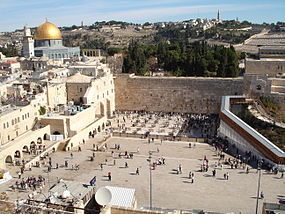
Thoughts on the "Western Wall"

The Western Wall is the wall known as the Wailing Wall, where Rabbinic Jews in Israel come to pray. It is specially now called the "Western Wall" to emphasise the "fact" that it is the western wall of the 2nd Temple. Indeed many of Jewish faith use this term to highlight this idea.

I would like to express my opinion as to why I do not believe this wall is part of the 2nd Temple. I do not mean any dis-respect to those who disagree with my opinion, they are entitled to their beliefs just as I am.


Now, there are evidences from historians and archaeologists who do not believe this wall is part of the last Temple. I admit they are a small number. I won't go into those evidences, for example that the wall was actually the wall of Fort Antonia and it used to be a Christian dump site, etc. Josephus an eye-witness of the 70 AD destruction by the Romans, wrote that the Temple was completely destroyed.

As a Christian, I will however offer my reason why I disbelieve that the "Western Wall' is part of the 2nd Temple. The reason is Jesus Christ - Jesus of Nazareth. Jesus said in Mk 13:2 And Jesus answered and said to him, “Do you see these great buildings? Not one stone shall be left upon another, that shall not be thrown down.”

Think of that for a moment,  that statement is very very crucial to your faith - be you a Christian or of another persuasion. Jesus said that no stone will be left upon another -  now if that wall is indeed part of the 2nd Temple and is even the western side of the Temple, then Jesus' prophecy failed and so Jesus is found to be a false prophet. He said no stone will be on top of another and yet there is that wall - a part of the Temple standing. So he is a false prophet and thus a false Messiah. This then mean also that the whole Christian faith crumbles, for we believe in a person who just lied and falsely prophesied to us. Did you get it?

Now, we have Josephus himself a non-believer of Christ who as a historian and eye-witness of the 70 AD destruction of the Temple by the Romans testified indeed that the whole Temple was completely destroyed.

Now assume for a moment if you come from Jewish persuasion and admit that the "Western Wall" might not be a part of the Temple, then Jesus' prophecy came to pass and that means he is worth pursuing. However I doubt and am pessimistic if the Jewish authorities in Israel will change their minds about this - the reason is that asserting the "Western Wall" to be part of the Temple is also asserting that Jesus is a false Messiah and that justifies ignoring the claims of Jesus of Nazareth.

If the real location of the Temple is not in the "Western Wall", then Jews and Muslims can give up the fight for  the control of this area.  Everybody wins.

As a Christian, we have no care of any Temple at all, at least I for one do not care. The reason again is Jesus and what Apostle Paul said - Jesus said in Jn 4:21 that we will not worship in any mountain nor in Jerusalem and in Mt 12:6  he said -- But I say to you, That in this place is one greater than the temple.    Then the Apostle Paul said in 1 Cor 6:19 that our bodies are the Temple of the Holy Spirit.

Won't it be a shame if WWWIII began based on a false belief of a holy site?

Monday, October 13, 2014

Why I listen to Dr. Ichabod's Sermons.

Why do I listen to Dr. Greg Jackson's sermons? Very simple reason. Not for the eloquence, not for lofty and clever speeches, not for terrific engaging style, none of that. Only one thing - he encourages me to have faith in Christ and in Christ's Word by simple exposition of the text.

How pathetic, Lutheran preachers, reads a text of Scripture but then go talk about something else during the homily so you wonder after the service, what was it all about? Did I get something from that?


I observe that people have an over estimation of themselves. I observe most Lutherans in particular and Protestants in general, believe they have no problem with faith that is why they listen to false teachers that pat them in their sin.

I live with myself all the time and I know how I allow my anxiety to overwhelm me.

Luther was right when he said, we neither fear, nor love nor trust God. At least what he said was true about me. I confess my sins each Sunday but the root of those sins is one source - my lack of faith.

I need to be prodded to believe God, that Christ covers my sin, that God will take care of me even though I have been unfaithful, that God will not leave me nor forsake me and will provide for me etc etc. Lack of faith, that is the diagnosis of my decease - I go for the preacher who stirs me in this faith direction, that is why I listen to Dr. Jackson's sermons.


Wednesday, August 20, 2014

Christ my only hope

I have just been thinking the other day.

I was alone with my thoughts. It dawned on me in a deep and profound sense that without Christ, I have no hope for the forgiveness of sins and how hopeless I would be without Christ. There is no other way, but to look to Christ for the forgiveness of all my sins.

Is this what it means to hope in Christ?

Romans 5:2-7

LPC


Tuesday, February 25, 2014

C. F. W. Walther - UOJ Theologian with no exegetical prowess, a Zitatentheolog

Over at Shaky Lutherans,  we see a celebration of ACLC's critical response to ELDONA's statement on Justification.  ELDONA, thank God, retreated away from  the doctrine of Universal Objective Justification (UOJ), the doctrine that says that God has ALREADY declared the world to be righteous, when Jesus was raised from the dead (or when he breathed his last at the Cross - UOJers are not uniform on this). Obviously such a move by a synod away from UOJ carries some traction and must be averted at all cost - it is just bad publicity, so all guns from UOJ synods are pointed at ELDONA today.

Needless to say the UOJers proudly fronted their hero, C.F. W. Walther by presenting him as the man with the final say. Here is an interesting quote...from Francis Pieper presented by Mr. Jim Pierce (an enthusiastic defender of UOJ).

Should, for instance, anyone deny the universality of Christ’s redemption, negating with Calvin the Scripture truth that Christ has redeemed all mankind and that in the Gospel God seriously offers to all men His grace without any discrimination, then he subverts the doctrine of justification. If that error is maintained, then the individual sinner cannot become personally sure of his salvation unless he receives an extraordinary, immediate revelation to that effect. Again, should anyone teach that Christ has indeed redeemed all men, but not completely, in other words, that Christ has indeed made forgiveness of sins possible for all men, but that this forgiveness of sins or justification does not yet actually exist for every sinner, then he makes faith and conversion a meritorious cause of the forgiveness of sins and invalidates the doctrine of justification by grace for Christ’s sake. Or, should anyone pervert the doctrine of the means of grace by denying that God offers the sinner His grace in Word and Sacrament so that the sinner must seek grace in Word and Sacrament, then he bids the sinner seek grace in his own subjective condition, in conversion and regeneration, and so in his own good works. Finally, should anyone pervert the doctrine of faith by denying that faith is essentially trust in the grace offered in the Gospel and by identifying faith with the feeling of grace, then he will put in place of divine grace the condition of the human heart as the basis of justification and salvation. Or should anyone teach wrongly concerning faith by ascribing the creation of faith to human co-operation or to man’s good conduct, then again he surrenders the Scriptural doctrine of justification despite the fact that he may use the expressions “by faith alone” or “by grace for Christ’s sake.” This subject seems to us so very important that we shall develop more fully the three points on the basis of many statements made by Walther. 

I highlighted the bolded text to show how UOJers commit the fallacy of tertium non datur. The reasoning goes like this, if you do not believe in UOJ then you MUST...believe in "faith as a work" or you MUST then believe in Limited Atonement... blah blah blah. None of this is true because the statement assumes that there are only two options that are mutually exclusive. This is the fallacy, it assumes there is no third alternative. Anti-UOJers do not believe in Limited Atonement and they follow the teaching that faith is a gift created by means of grace. At first blush the fallacy makes initial sense but this is demolished by a clear exposition of passages which purports to teach a Justification without and prior to faith.

A few months ago, I was search through the Internet and I found the thesis of a certain Rev. KARL EDWIN KUENZEL. This ThD thesis (2006) was about the doctrine of church and ministry in the ELS (of USA).  Of course, the thesis could not help but mention Walther because after all Walther wrote something about this subject. The author had some glaring criticism of Walther though we can also detect somehow his political stance of not overtly lambasting Walther. he swung between respect and disdain of Walther. Here are some interesting quotes. Some of the emphasis are mine...

Walther was a tremendous leader, a dynamic preacher, a powerful lecturer, and a remarkable 
writer. However, lest we wind up worshipping the man, as many had done with Martin Stephan, 
and perhaps some do with Luther, we need to be mindful of some of Walther’s deficiencies. 
Walther was legalistic when it came to the matters of usury, dancing and going to the theater, life 
insurance, running a tavern, in-law marriage (e.g., a man marrying the sister of his deceased wife), 
geographical parish boundaries, the local congregation and the pastoral office. He often made his 
position as if it were Scripturally based and therefore God-given doctrine, when, in fact, he was 
going beyond what the Bible says and turning matters of casuistry into untenable doctrines.

Not only did Walther use terms that were readily misunderstood by others, but another cause for 
his naevi [faults], according to his student August Pieper, was that Walther depended too heavily 
on the secondary sources of theology, i.e., Luther and the lesser fathers. In spite of all his 
emphasis on Scripture, there can be no denying this. Although Walther was a great, and a very 
talented leader, he was a poor, even an inferior exegete. He had only an average knowledge of 
the original biblical languages. Frequently he would cite dozens of Bible passages merely because 
Luther and the dogmaticians had done so. Yet these passages did not prove what they were 
supposed to prove. Although very eager to express himself on matters, he failed to recognize that 
his position was based on translations and not on the original text. Thus, he could say something 
as if it were doctrinally true, but without a firm scriptural basis. Over all, the knowledge of Scripture 
that Walther had was more an intimate acquaintance with Luther’s Bible and knowledge of certain 
passages rather than knowledge of the whole line of thought of a biblical book and of the original 
text.

 Another reason that is frequently cited for his use of this format is that he 
realized how inadequate his knowledge of Scripture and doctrine really [LPC: I suppose compared to Hoenecke]was in comparison with 
Luther and Chemnitz, Gerhard and Calov, thus in all modesty he was afraid of going astray in 
even the smallest point of doctrine.

Walther was a great leader and the Lutheran Church benefited much from his leadership, still no 
matter how justified Walther’s method of citing Luther and the Lutheran dogmaticians might have 
been in the beginning, it was wrong both in principle and in practice. The problem was that unlike 
Luther, who stressed the Bible and the study of the Bible, Walther’s positions neither rested 
directly on Scripture nor did they lead one directly into it. Instead he strongly stressed, to the 
extreme, the importance of Luther and the Lutheran Confessions and the Lutheran fathers, and 
certainly much more than he cited God’s Word. Utilizing this format Walther led people to think that 
the matter under discussion or being presented had been established sufficiently by the quotations 
from Luther and the fathers; therefore it was unnecessary to study Scripture. This format actually 
hampered people in their use and study of the Bible. And eventually, it has come to the point 
where the citation theologians not only quote Luther and the old fathers but now they have also 
included Walther and others as proof of the doctrinal stand. As pastors, theologians, and 
theological students took up the study of doctrinal maters in subsequent years the subject of study 
was not as much a study of the Bible as it was a study of old synodical reports and conference and 
convention essays. And now quotations from these, not the Bible, are frequently used to support 
doctrinal positions

However, it was unsettling to have Walther take a firm stance on a matter citing the Lutheran fathers as his proof, yet not realizing that at the same time his position was in contradiction to what they had written 


----
LPC: Is it any wonder why UOJ has damned souls and caused confusion? It was promoted by someone who knew more secondary sources rather than the Scripture itself, what do we expect?